Solutions · For beauty & cosmetics brands
The Claim Check Agent checks every claim against its evidence before it reaches the pack, the page or the ad.
- Made for
- Beauty and cosmetics brands, from founders to marketing and regulatory teams
- You get
- Claim substantiation file and compliant copy
Opens in Fashion mode, brief filled in. Standard plan and above.
The job, before and after
Without it
The claim ships and is pulled by a regulator or a retailer with the print run already paid for.
With McLeuker AI
Substantiate the claim before it is printed on the pack.
Every launch, every reformulation, every new market.
Why it is hard
Beauty moves on claims, and a claim is a regulatory position as much as a marketing one. The work is knowing what the evidence supports, what each market lets you print, and what your competitors are getting away with.
The agent
The Claim Check Agent
The agent checks every claim against its evidence before it reaches the pack, the page or the ad.
Check our claims before print with the Claim Check Agent.
You fill in
- Product
- name
- Copy
- attach pack copy, product page, ad script
- Markets
- e.g. EU, UK, US
- Evidence we hold
- attach study reports and certificates
Read
Phase 1 of 4
- 01
Reads the pack copy, product pages and ad scripts
- 02
Extracts every claim: efficacy, environmental, free-from, "clinically"
- 03
Classifies each claim by type and target market
Judge
Phase 2 of 4
- 04
Matches each claim to the evidence class it needs
- 05
Reads the study reports the brand holds
- 06
Checks the wording against the strength of the evidence
- 07
Applies EU cosmetics claim criteria and the new green-claim rules
Fix
Phase 3 of 4
- 08
Flags banned generic environmental claims
- 09
Rewrites to compliant wording that still sells
- 10
Benchmarks competitors' claims on shelfBrand Omniscan
Keep
Phase 4 of 4
- 11
Builds the claim substantiation file for the product dossier
- 12
Re-checks the claims register when you reformulate or open a new marketBeta
Claim substantiation file and compliant copy
Open an example: Claims Substantiation BriefingIn depth · Judge
The evidence decides the sentence.
Marketing treats these five as one category called proof. A regulator does not, and neither does the retailer who asks for the file.
- 01
Consumer perception
A panel reported how it felt. Self-assessment, not measurement.
What it carries
Testers said skin felt smoother after four weeks.
Attributed to the panel. It is never stated as an effect.
- 02
In vitro
A measured effect in a dish, on cells or a model membrane.
What it carries
Shown in laboratory testing to support the skin barrier.
Mechanism only. It is not yet a claim about skin.
- 03
Instrumental
An instrument measured a change on real skin, under a named protocol.
What it carries
Hydration measured on skin for 24 hours, protocol and panel stated.
The first tier that can carry a duration.
- 04
Clinical
Controlled, on a defined population, with the endpoint agreed in advance.
What it carries
Clinically shown to reduce the appearance of fine lines.
The first tier that can carry an efficacy claim.
- 05
Published
Peer-reviewed and citable by anyone who wants to check it.
What it carries
Published, peer-reviewed evidence, and it holds against a rival.
The only tier that survives a comparative challenge.
What you want to say, and what has to carry it.
The claim decides the evidence, the category and sometimes the market. Getting that order right at brief stage is cheaper than finding it at artwork.
| The claim | What has to carry it | As written |
|---|---|---|
| Hydrates for 24 hours | Instrumental corneometry on a panel, with the protocol and the n stated | Carried |
| Reduces the appearance of fine lines | Expert grading or image analysis - cosmetic appearance, not structural change | Needs substantiation |
| Repairs the skin barrier | Reads as a physiological action, which moves the product across a category line | Restricted wording |
| Dermatologist tested | A named study under supervision - tested is not the same as approved | Needs substantiation |
| Clean / non-toxic | No agreed definition, and several markets treat the implied slur on other ingredients as denigration | Restricted wording |
| 97% natural origin | A calculation under a named standard, with the method printed beside the figure | Carried |
Claim types and the evidence class each needs. What a market allows this season is read live against the current rules, with sources - a table printed here would be stale before you used it.
How the Judge phase reads a claim: the evidence tier decides the sentence, then each claim is run through it.
What you get
Claim substantiation file and compliant copy.
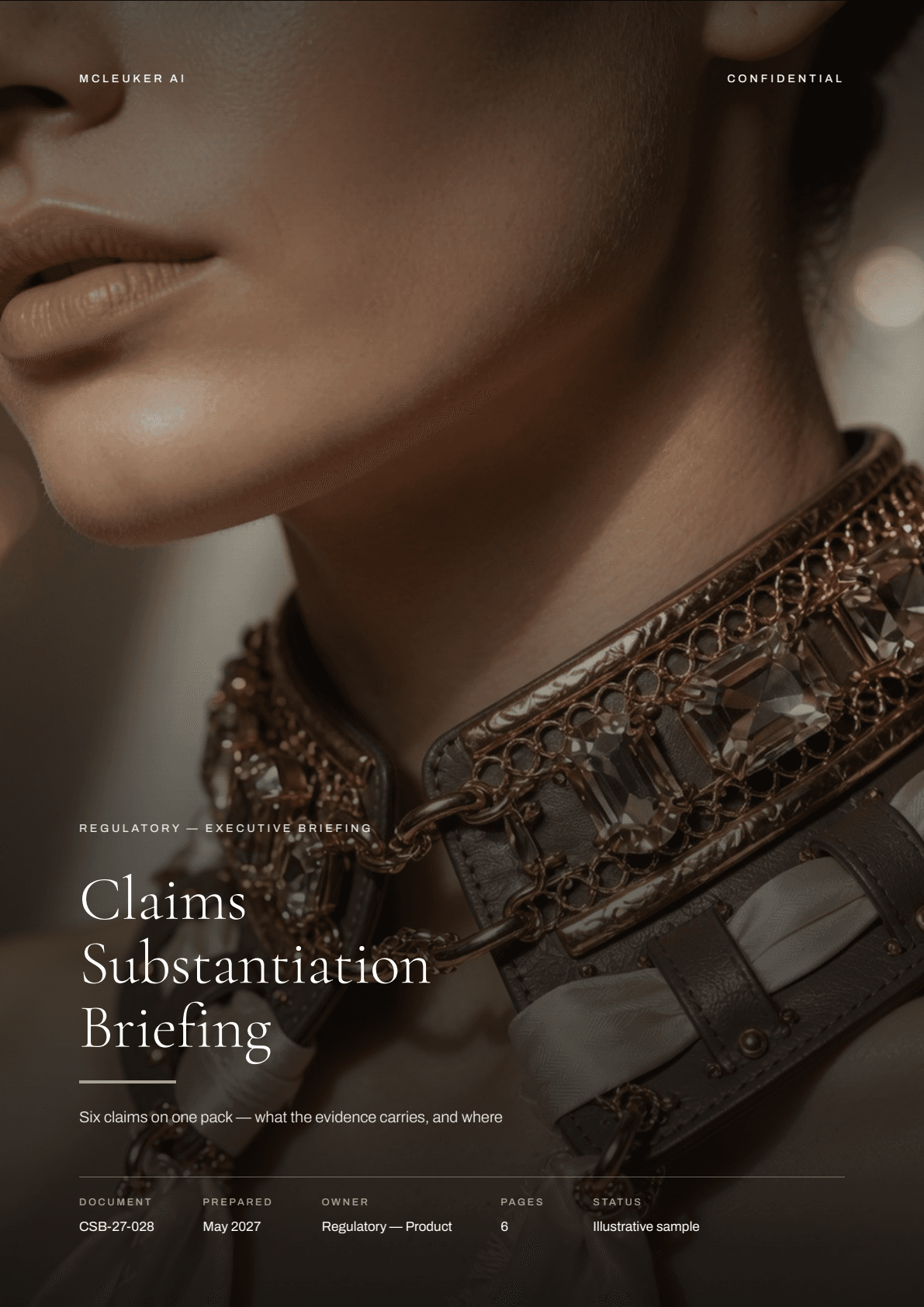
The Claims Substantiation Briefing, opened page by page. An example made on McLeuker AI. Its brand and figures are illustrative, as its cover says.
 Claims Substantiation Briefing · page 1 of 6PDF · Open the file
 Claims Substantiation Briefing · page 2 of 6PDF · Open the file
 Claims Substantiation Briefing · page 3 of 6PDF · Open the file
 Claims Substantiation Briefing · page 4 of 6PDF · Open the file
 Claims Substantiation Briefing · page 5 of 6PDF · Open the file
 Claims Substantiation Briefing · page 6 of 6PDF · Open the file
Reports
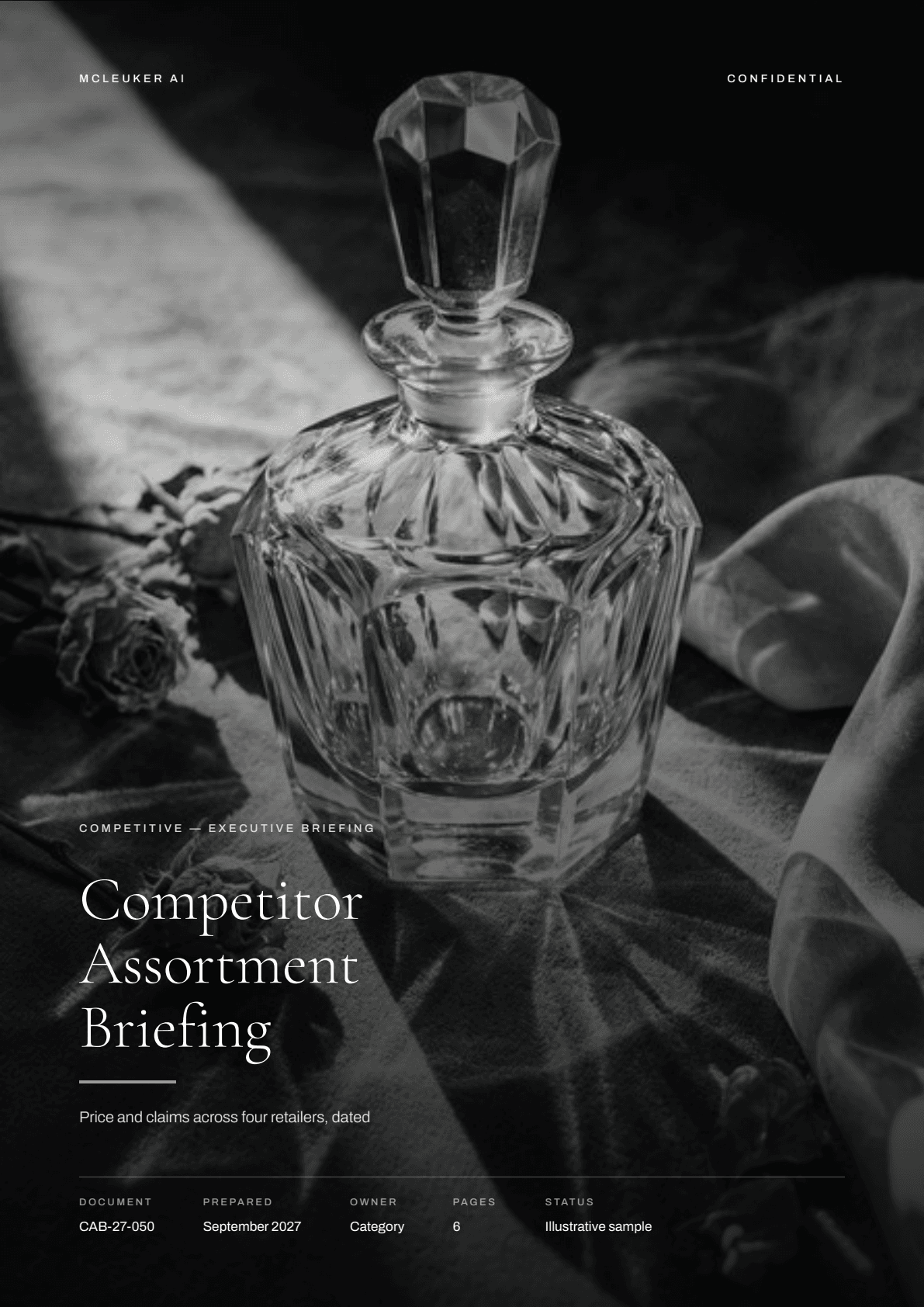
2 briefings written for beauty & cosmetics.
Each one is the finished file, opened in full. Every figure in them is illustrative and each says so on its own cover; a real run researches and cites its numbers with an as-of year.
Start
Start the Claim Check Agent.
Its brief opens in the composer. Fill in the [brackets] and send.
Fashion mode, on the Standard plan and above.
Next lane: Retail operations teams. The same green-claims screen, run on product copy as it goes live.
Questions
Before you start.
What does it cost to start?
Signing up costs nothing. There is a Free plan and no card is needed: 300 welcome credits when you verify your email, 100 daily credits you can claim every 24 hours, and 3 questions a day in Instant and Thinking. The agents on the solution pages run in Fashion mode, which opens on the Standard plan and above. What each plan opens is on the pricing page.
How long does a run take?
It depends on the job. A studio run is minutes: a fashion collection takes about three minutes end to end, and a product campaign set about two minutes forty. An agent works through every step of its run and stops when the file is finished, so it takes longer; you can follow each step as it runs.
What do I need to bring?
A question or a brief is enough to start. Studios that work from your own material take it directly: a product photo, a store link or a description for a campaign; garments and a model or your own photo for try-on; a sketch, a reference or an existing spec for a tech pack. You can attach files to a message - one file of up to 10 MB on the Free plan, more on paid plans.
Can I edit the files afterwards?
Yes. Decks are PowerPoint with real text boxes, shapes and native charts; spreadsheets have typed cells and live formulas; Word documents keep their styles, headings and a table of contents that updates. Research reports come as an editable PDF or DOCX.
Is my data used to train models?
No. McLeuker AI does not use your content, your files or your connected-account data to train or fine-tune AI models, as the Privacy Policy and the Terms both state. Limited, aggregated and de-identified logs may be used to improve reliability and security.
Does this cover the new EU green-claim rules?
Yes. Since 27 September 2026, EU consumer law prohibits generic environmental claims such as “green” or “eco-friendly” unless the trader can demonstrate recognised excellent environmental performance relevant to the claim, such as the EU Ecolabel. There is no grace period for existing stock: a product on the shelf or online to EU consumers after that date must comply. The agent screens every environmental claim against that rule and the EU cosmetics claim criteria, and proposes wording the evidence carries. The national law that transposes the Directive is the enforceable text in each member state.
Is this regulatory advice?
No. It researches the rules and the evidence behind a claim and cites them, so your team can decide faster; it does not replace a regulatory sign-off. The Terms state that the service does not provide legal advice.