McLeuker AI
Pricing
Sign inGet started

Products · Tech pack

Design in, factory-ready spec out.

A bill of materials, points of measure, construction notes and callouts, as an editable XLSX or PDF. What it will not do is invent a number: every value your production team still has to sign off is left visible, so what you review is a draft rather than a guess wearing a spec's clothes.

Try the tech pack generatorOpen the whole set
Files
4
Formats
PDF · XLSX
Lead pack
ARQ-SS27-011
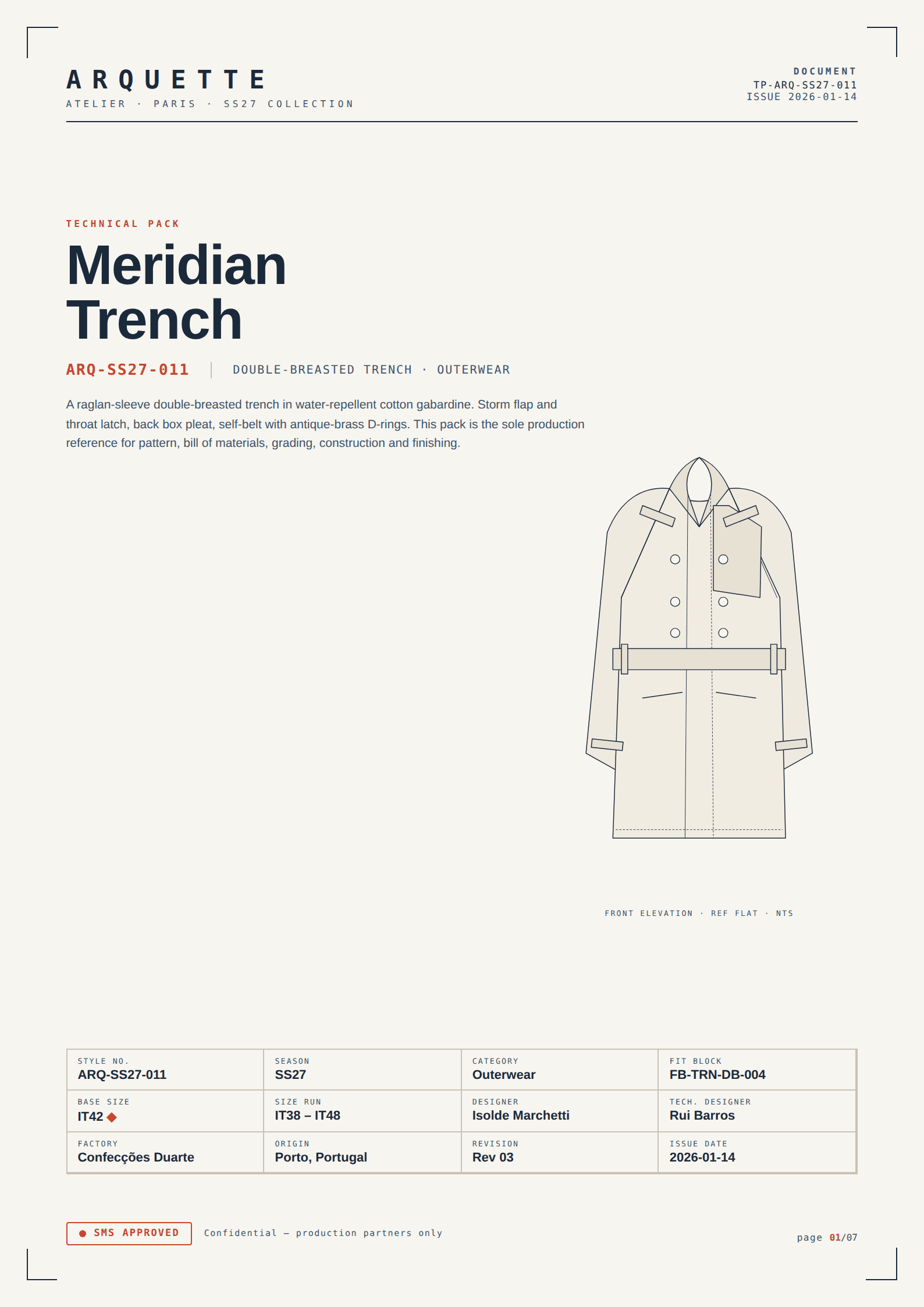
Page one of a technical pack generated by McLeuker AI, showing line-art flats and a measured specification table
ARQ-SS27-011 · page 1 of 7
  • Bill of materials
  • ·Points of measure
  • ·Construction notes
  • ·Grading rules
  • ·Trim callouts

The wrong artefact

A cutter cannot sew from a render.

Ask most generative tools for a garment spec and a photoreal image comes back, because that is what they are good at. On a build package it is not a weaker answer, it is the wrong kind of thing, and it fails in three specific ways.

  1. 01

    It hides the seam lines

    The one thing a cutter needs to see is exactly what a soft render smooths away.

  2. 02

    It invents construction

    A generated garment resolves a join it was never told about. The factory builds the invention.

  3. 03

    It lies about proportion

    Nothing in a render is to measure, so a pocket that reads right on screen is a re-sample in the flesh.

So the package is drawn the way a factory is used to receiving one: closed line-art flats front, back and detail, with the measurement callouts leadered off them, and the tables carrying the instruction. The flat is the index. The tables are what gets built.

How a pack is built

One of the passes is leaving a blank.

A specification is not a description of a garment. It is a set of numbers a stranger in another country will cut against, so the interesting question is never what the document says: it is which parts of it are known and which are still yours to decide.

  1. 01

    Describe the garment

    In words, from a sketch, or from a photograph of a sample on the table. What matters is the construction you intend rather than the styling: how it closes, how it is joined, where it is meant to sit on the body.

    Written briefA sketchA sample photo
  2. 02

    It computes the tables

    Points of measure, the graded size run and the increments between sizes are arithmetic against a base, not prose. That is the half a language model should never be improvising, so it is calculated and laid out as a table somebody can check line by line.

    Points of measureGrade rulesSize run
  3. 03

    It draws the flats and the callouts

    Line art, front and back, with the callouts pinned to the seams and trims they refer to. A callout that cannot be found on the drawing is a note, and a note is what gets ignored on a factory floor.

    Front and backSeam calloutsTrim cards
  4. 04

    It leaves your decisions visible

    Supplier, fabric reference, exact colour standard, tolerance: the values only your production team can sign off are left marked rather than filled with something plausible. An invented number is worse than a blank, because a blank gets questioned and a number gets cut.

    Marked, not guessedYours to sign off
Try the tech pack generator

What it will not do is invent a value nobody gave it.

One reading

Every callout has to survive being read by a stranger.

The test is whether a factory could read it two ways. Where it could, the package removes the choice - and where a value genuinely is not yours to invent, it is left marked for you to confirm rather than filled in with something plausible.

  • Soft handA named fabric, composition and weight, so the hand is a consequence rather than an adjective.
  • Chest 52 cm52 cm at a named landmark, with the how-to-measure, the grade increment per size and the tolerance the factory is held to.
  • Match the navyA Pantone TCX code against a named placement. Screen colour lies, so the code travels, not the swatch.
  • Topstitch the hemA stitch class, stitches per inch and seam type, so two factories build the same hem.

Measurements are computed against the size-rule table and checked back against the tolerance band, not recalled from anywhere. That is the difference between a spec that proves it was worked out and one that reads like it was.

Four documents, four jobs

Everything a factory receives.

The four files a garment cannot be made without: the pack that specifies it, the sheet that says how it is cut and joined, the graded size run, and the trim cards somebody signs. Four real programmes, one of each. Page through any of them, then download the file - the XLSX opens with typed cells and formulas, not a picture of a table.

Technical Pack - ARQ-SS27-011 Meridian Trench - page 1, produced by McLeuker AI

Technical Pack - ARQ-SS27-011 Meridian Trench

PDF · page 1 of 7

Download the PDF

Switch deliverable

Who reads the pack

Between a drawing and a delivery.

A pack is the one document every one of these people has to agree on, and each of them opens it looking for something different.

Design and product development

The drawing has to survive being turned into instructions without losing the thing that made it worth making. Getting a first pack out in an afternoon means the conversation with the factory starts from a document rather than from a description.

DesignerProduct developer

Sourcing and production

A supplier quotes against what is written down, so anything vague becomes either a question or an assumption, and assumptions turn up in the sample. Blanks that are visibly blank get answered before costing; invented values get discovered after cutting.

Production leadSourcing

Technical and fit

Fit is a conversation held in measurements across sizes, and it only works if the increments are consistent. A graded run laid out as typed cells can be corrected and re-issued; one laid out as a picture of a table has to be rebuilt.

Garment technologistFit lead

Small brands and studios

Without a technologist on staff, the pack is usually the thing standing between a good sample and a bad one. Having the structure a factory expects, with the unknowns marked, is what makes a first order a negotiation instead of a gamble.

FounderStudio manager

Get started

Describe the garment. Get the pack.

A draft a production lead approves, with the values you still have to confirm left visible rather than papered over.

Try the tech pack generatorView pricing

Keep exploring

Related tools & solutions.

Fashion Lookbook

Present the same collection as an editorial digital lookbook.

Virtual Try-On

See the garment worn before a sample is cut.

Production & Specs

The rest of the paperwork a season runs on.

Supplier Sourcing

Find and vet the factories your tech pack goes to.

How to create a tech pack with AI

A step-by-step guide to the draft-then-review workflow.

Textile sector

The material vocabulary a spec has to be written in.

McLeuker AI

AI-powered fashion intelligence platform. From trend analysis to supplier sourcing - structured, professional, and ready to act on.

PricingOpen the app

Weekly fashion intelligence, straight to your inbox.

Paris, France

Also from McLeuker

mcleuker.com

Same company, two services. McLeuker AI is the platform; mcleuker.com is the fashion-tech & agentic-AI consulting practice.

Solutions

  • Fashion brands
  • Retailers & buyers
  • Luxury houses
  • E-commerce & DTC
  • Manufacturers & suppliers
  • Marketplaces & resale
  • Agencies & studios
  • Independent designers
  • Beauty & cosmetics
  • Fashion students
  • Media & publishing
  • Groups & enterprise
  • Sourcing
  • Retail operations

Products

  • Deep Research
  • Reports (PDF, PPTX, Word, Excel)
  • Website Builder
  • Fashion Collection
  • Product Campaign
  • Virtual Try-On
  • Moodboard
  • Fashion Lookbook
  • Image
  • Video
  • Audio
  • Podcast
  • Whiteboard Design
  • Tech Pack

By Sector

  • Fashion
  • Beauty
  • Skincare
  • Textile
  • Lifestyle
  • Catwalks
  • Culture
  • Sustainability
  • Fashion Tech

Resources

  • How it Works
  • Agentic AI
  • Compare
  • Examples
  • Gallery
  • Report Examples
  • Fashion Reports
  • Blog
  • AI Glossary

Company

  • Team
  • Careers
  • Press
  • Contact
  • Help / FAQ

Legal

  • Acceptable Use
  • AI Transparency
  • Browser Operator Privacy
  • Security & Trust
  • Subprocessors
  • Data Requests

All systems operational

·

© 2026 McLeuker AI. All rights reserved.

PrivacyTermsCookiesMentions Légales