Solutions · For mills, factories and converters
The RFQ Response Agent answers a buyer's RFQ and compliance request the same day, from one evidence vault.
- Made for
- Mills, factories and converters - their sales and quality teams
- You get
- Same-day quote and due-diligence pack
Opens in Fashion mode, brief filled in. Standard plan and above.
The job, before and after
Without it
The order goes to whoever answered first, and a lapsed certificate is found by an auditor rather than by you.
With McLeuker AI
Return the buyer's due-diligence pack the same day it is asked for.
Every enquiry, every re-quote, every audit.
Why it is hard
A supplier is judged on documents long before anyone sees a garment: the quote, the test report, the certificate, the inspection. This is the side of sourcing nobody builds software for.

The agent
The RFQ Response Agent
The agent answers a buyer's RFQ and compliance request the same day, from one evidence vault.
Answer this buyer's RFQ with the RFQ Response Agent.
You fill in
- Buyer and RFQ
- attach the RFQ, spec and questionnaire
- Our factory
- name, country
- Our certificates
- e.g. GOTS, OEKO-TEX 100, with numbers
- Reply due
- date
Read
Phase 1 of 4
- 01
Reads the buyer's RFQ, spec and questionnaire
- 02
Maps each question to the factory's evidence vaultBeta
Check
Phase 2 of 4
- 03
Checks the factory's own GOTS and OEKO-TEX certificates against the issuing registry: status and scopeBeta
- 04
Flags a certificate the registry shows as expired, missing or held by another company, before the buyer doesBeta
Answer
Phase 3 of 4
- 05
Rewrites the spec in the buyer's tech-pack formatTech Pack
- 06
Assembles traceability evidence down to fibre and yarn
- 07
Builds the due-diligence pack in the buyer's template
- 08
Drafts the quote reply, ready to send
Keep
Phase 4 of 4
- 09
Tracks open RFQs and follows upBeta
- 10
Updates the vault after every audit and renewal
Same-day quote and due-diligence pack
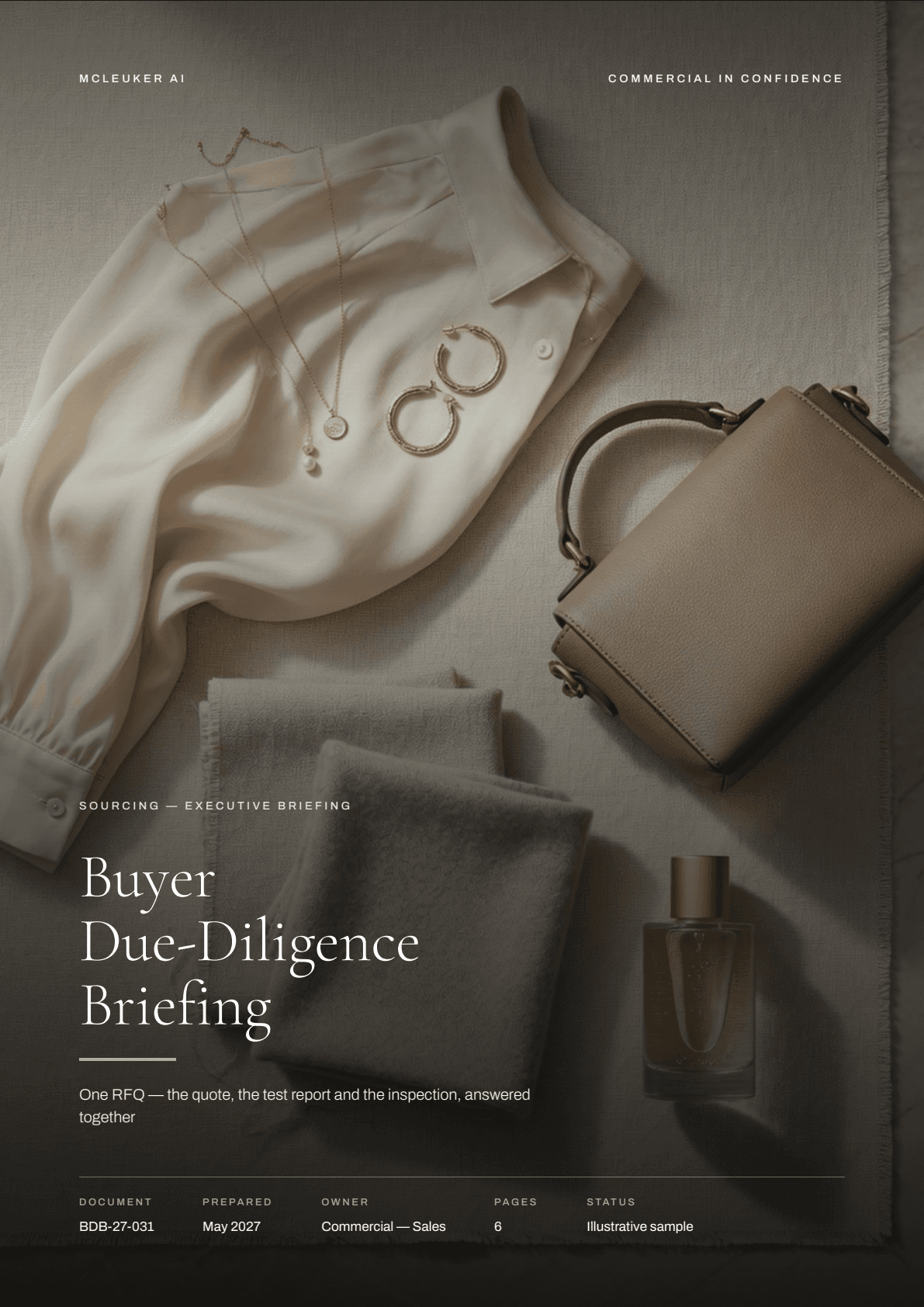
Open an example: Buyer Due-Diligence BriefingIn depth · Check
The certificate is only as good as its weakest link.
A PDF looks like proof. Whether it covers this holder, this process and this shipment is five separate questions, and one no is a no.
- 1Exists
Is this certificate real, and is it live today?
A PDF of a certificate that lapsed last quarter looks identical to one that did not.
- 2Holder
Whose certificate is it?
Held by the trading company or the group, not by the mill that will actually make your cloth.
- 3Scope
Does it cover this product and this process?
Valid for organic cotton when the order is a blend, or for weaving when you need dyeing.
- 4Transaction
Does it cover this shipment?
A scope certificate proves the site is certified; only a transaction certificate ties it to your goods.
- 5Chain
Is every step in between certified too?
One uncertified converter in the middle and the claim on the finished product is gone.
A chain, not a checklist: four of five is not most of the way there, it is unproven. No scheme is ranked - the links hold for every certification body.
The five questions a buyer asks of a certificate. Against the registry, the agent checks the first three for GOTS and OEKO-TEX; transaction and chain evidence comes from the documents you hold.
What you get
Same-day quote and due-diligence pack.
The Buyer Due-Diligence Briefing, opened page by page. An example made on McLeuker AI. Its brand and figures are illustrative, as its cover says.
 Buyer Due-Diligence Briefing · page 1 of 6PDF · Open the file
 Buyer Due-Diligence Briefing · page 2 of 6PDF · Open the file
 Buyer Due-Diligence Briefing · page 3 of 6PDF · Open the file
 Buyer Due-Diligence Briefing · page 4 of 6PDF · Open the file
 Buyer Due-Diligence Briefing · page 5 of 6PDF · Open the file
 Buyer Due-Diligence Briefing · page 6 of 6PDF · Open the file
Reports
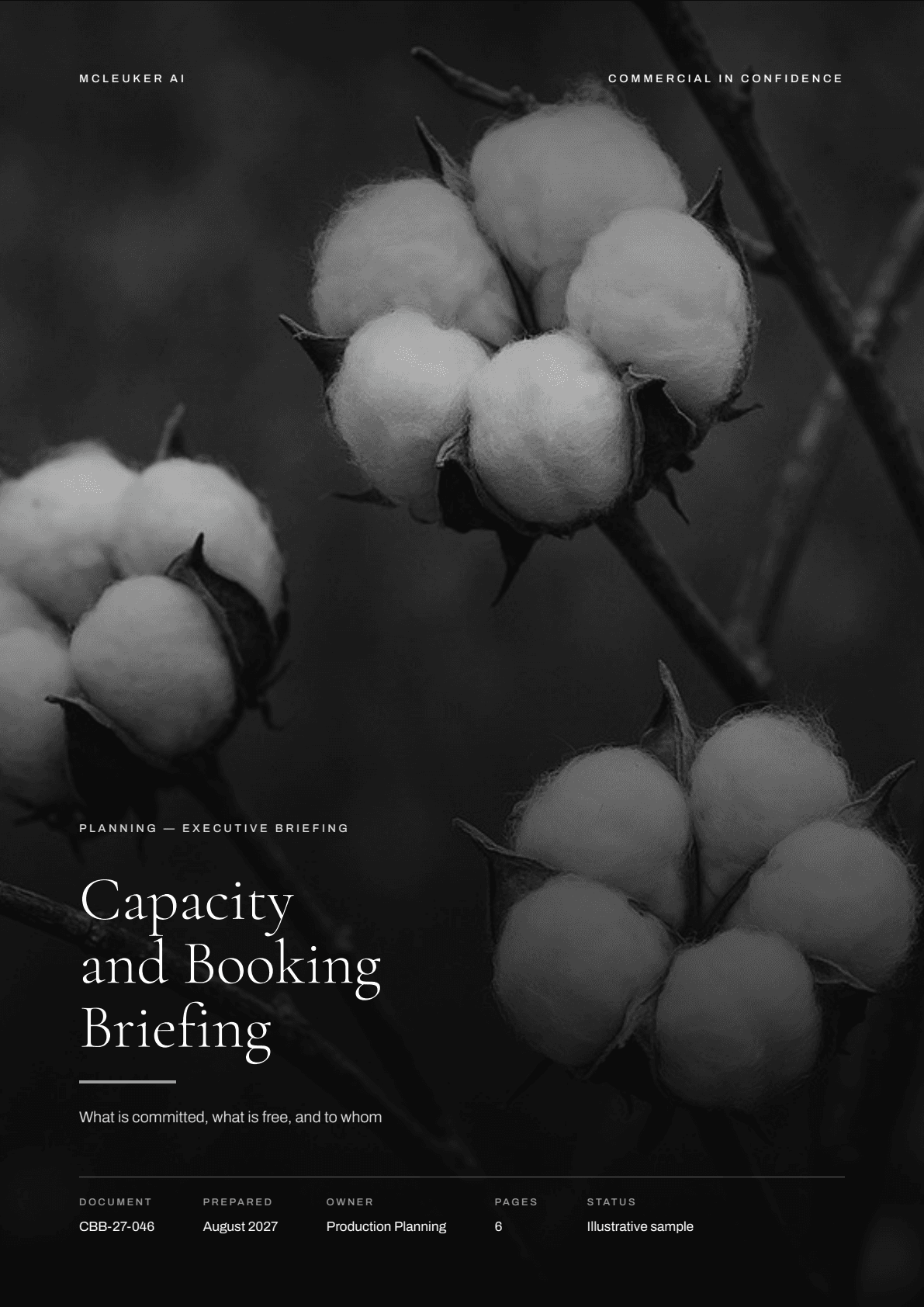
2 briefings written for manufacturers & suppliers.
Each one is the finished file, opened in full. Every figure in them is illustrative and each says so on its own cover; a real run researches and cites its numbers with an as-of year.
Start
Start the RFQ Response Agent.
Its brief opens in the composer. Fill in the [brackets] and send.
Fashion mode, on the Standard plan and above.
Next lane: Sourcing teams. The other side of the same RFQ: the buyer qualifying you.
Questions
Before you start.
What does it cost to start?
Signing up costs nothing. There is a Free plan and no card is needed: 300 welcome credits when you verify your email, 100 daily credits you can claim every 24 hours, and 3 questions a day in Instant and Thinking. The agents on the solution pages run in Fashion mode, which opens on the Standard plan and above. What each plan opens is on the pricing page.
How long does a run take?
It depends on the job. A studio run is minutes: a fashion collection takes about three minutes end to end, and a product campaign set about two minutes forty. An agent works through every step of its run and stops when the file is finished, so it takes longer; you can follow each step as it runs.
What do I need to bring?
A question or a brief is enough to start. Studios that work from your own material take it directly: a product photo, a store link or a description for a campaign; garments and a model or your own photo for try-on; a sketch, a reference or an existing spec for a tech pack. You can attach files to a message - one file of up to 10 MB on the Free plan, more on paid plans.
Can I edit the files afterwards?
Yes. Decks are PowerPoint with real text boxes, shapes and native charts; spreadsheets have typed cells and live formulas; Word documents keep their styles, headings and a table of contents that updates. Research reports come as an editable PDF or DOCX.
Is my data used to train models?
No. McLeuker AI does not use your content, your files or your connected-account data to train or fine-tune AI models, as the Privacy Policy and the Terms both state. Limited, aggregated and de-identified logs may be used to improve reliability and security.
Which certification registries are checked live?
GOTS, and OEKO-TEX Standard 100 and Made in Green, read against their public registries: whether the certificate exists, who holds it and what it covers, each result stored with the date of the check.
What does the EU forced-labour regulation change for a factory?
From 14 December 2027, products made with forced labour may not be placed on the EU market or exported from it. The Regulation sets no mandatory due-diligence duty, but the Commission’s guidelines of 30 June 2026 stress traceability. The agent assembles the traceability evidence you hold into each buyer's template, so the same evidence answers every buyer.