Solutions · Brand intelligence
Read the competitive set the way they would read you.
Positioning, assortment, price architecture and the archive - assembled from what the brands themselves published, with every claim traceable to where it was said.
- specialists the read is split across
- 4
- playbooks it reaches for
- 5
- studios it runs through
- 3
What a competitive read is really asking
Three questions, and the condition each answer holds under.
Generic AI tools see the brand's website. This reads the filing, the runway press, the pin velocity, the resale premium and the regulatory record - every primary signal that actually moves a fashion brand. What is hard is not finding an answer; it is knowing when the one you found stopped being true.
WHERE ARE THEY POSITIONED. Read from the assortment rather than the about page: what they actually stock, at what depth, at what prices, is a position; what they say they stand for is a wish.
Positioning read from the range is a snapshot. It changes at every drop, so the date on the read matters as much as the read.
WHAT DOES THE PRICE ARCHITECTURE SAY. Entry, core and top price points describe who they think the customer is, and the gaps between them describe what they are afraid of.
A promotional price is not a price point. Mixing the two makes a discount-led brand look like a value-led one.
WHAT HAS THE ARCHIVE ACTUALLY HELD. What a house showed, and when, read back from what its own site, press and portfolio said at the time rather than from what anybody remembers now.
The recollection and the record diverge fastest on exactly the seasons people most want to cite.
What a brand publishes about itself
Four surfaces, and they do not always agree.
Positioning read from what a brand actually ships is a position; what it says on its about page is a wish. These are the surfaces the read is assembled from.

01The campaign

02The product page

03The press

04The wholesale book
How a set is actually read
A position is a relationship, not a score.
Two axes and a set of competitors is the most legible thing in competitive work, and picking the two axes is the whole skill - a map handed to you with somebody else's axes has answered the easy question. The marks below are illustrative: WHERE a real set lands is what the research produces, and this platform will not place a named company at a coordinate it did not measure.
01Strong on both, and priced below the set. The hardest position to hold, and usually the one under-invested in.
02Strong on both at a premium. Defensible, and where most houses believe they already are.
03Weak on both at entry price. Crowded, and competing only on availability.
04Weak on the second axis at a premium. The position a competitor is one campaign away from attacking.
The one job this page is about
Catch a competitor's move while you can still respond to it.
- How often it comes round
- Weekly - drops, price moves and claims land on their calendar, not yours.
- Skip it once
- You find out from your own sell-through, which is after the response window has closed.
The competitive set
You learn they moved from your own sell-through.
You learn a competitor moved from your own sell-through.
By the time it shows in your numbers they have had a season of it, and you react into their lead.
What we do
Assortment and pricing are captured and diffed over time, so a move surfaces as a change since last visit.
- Competitor price and assortment tracking
- Watchlist and alerts
- Cross-platform social listening
Nobody knows who actually owns them.
Ownership decides pricing power and shared factories, and it is hard to see from outside.
What we do
The group, portfolio and shared supplier pools are mapped, with the numbers read from filed accounts.
- Ownership and factory mapping
- Filed company financials
- Competitor price and assortment tracking
The brand dossier takes a week and is stale on delivery.
Assembled by hand from a dozen tabs, so it is expensive to make and nobody remakes it.
What we do
Produced in one pass and re-runnable, so it is a live read rather than a document that ages.
- Brand history at a past date
- Cross-platform social listening
- Filed company financials
Read a dossier
Open a brand dossier.
From a single brand name to a fully-cited read on positioning, moves and momentum. Page through one and download the file.
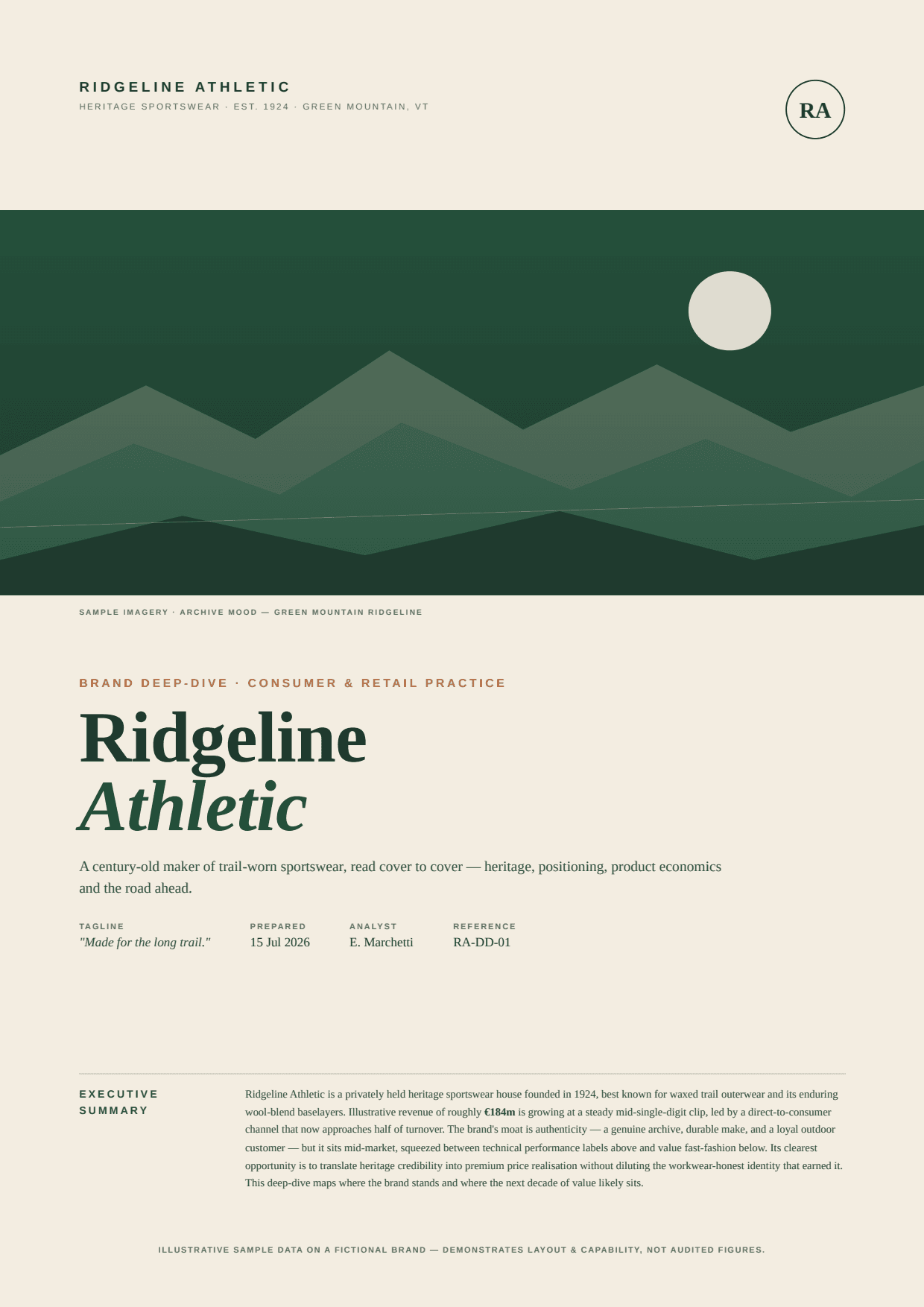
Brand Deep-Dive
PDF · page 1 of 7
Switch deliverable
The watchlist
Everything a competitor's move touches.
A competitive read is a research job before it is an opinion.
- 01Deep ResearchStudio
- 02Reports (PDF, PPTX, Word, Excel)Studio
- 03Website BuilderStudio
- 04Brand AnalystSpecialist
- 05ResearcherSpecialist
- 06AnalystSpecialist
- 07Communications LeadSpecialist
Competitor price and assortment tracking · Filed company financials · Ownership and factory mapping · Cross-platform social listening · Brand history at a past date · Watchlist and alerts
Built for/Strategy & insight, Brand & marketing
Get started
Try Brand Intelligence AI
Ask about any brand, any competitive set, any market.